
Northpoint | Blog
Wet Paint or Powder Coating: Which Does Your Component Need?
Although most components can be powder coated, it is not the right solution for every application. Choosing between powder coating and wet spray painting helps you avoid rework, delays, or a coating system that does not meet the specification.
The choice is not simply about finish or colour. Component size, substrate, operating environment, corrosion class and the specified coating system all help determine the appropriate process.
Northpoint provides specialist paint services including powder coating and wet paint services. This guide explains when a job needs wet spray painting, when powder coating is the better option, and what to consider before choosing a coating system.
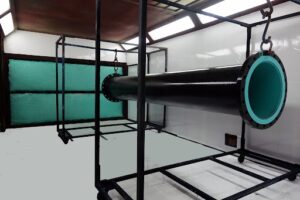
What is wet spray painting?
Wet spray painting uses liquid coating applied by spray to a prepared surface. Depending on the coating system, it can cure naturally in controlled conditions or be cured using an oven. Multiple coats can be applied, with primers, intermediate coats and topcoats selected to provide the required level of corrosion protection, chemical resistance or service performance.
The practical difference between wet spray painting and powder coating is straightforward. Powder coating applies dry powder, which is electrostatically charged and then fused onto the component in an oven. Wet spray gives greater flexibility in coating chemistry and in building up a specified multi-layer system.
That flexibility makes wet spray particularly useful where a component has demanding technical requirements, cannot be heated or needs a coating system selected for a specific operating environment.
When is powder coating a better option than wet spray?
Powder coating is usually the better choice for standard steel fabrications when the component fits the oven, and the specification does not require a bespoke coating system. It provides a tough, consistent finish per coat, is efficient for volume runs and avoids solvent emissions associated with liquid paint systems.
It is particularly well suited to standardised components where a consistent finish, repeatability and production efficiency are important. If you do not need a specialist liquid coating system, powder coating can often provide the most straightforward and efficient solution.
The key is to assess the component and specification first. Consider size, substrate, operating environment, and the required coating system before choosing a process. Northpoint also provides sheet metal coatings and can advise whether powder coating or wet spray painting is the better option for your component.
To learn more about how powder coat paint works and when it is the right choice, see our blog: powder coating: the top ten questions.
Five cases where wet paint is the only option
Wet paint is usually the right choice when a component needs a tailored multi-layer coating system or specialist chemistry to meet a specific industry standard. This is particularly relevant in demanding sectors such as nuclear, oil and gas, renewables, aerospace, water treatment and defence.
Here are five factors that can make wet spray painting the better option:
1. The component is too big for the oven
Component size can rule out powder coating where the part cannot fit inside a curing oven. Northpoint’s SprayBake booth can accommodate components up to 12 metres long, 4 metres wide and 2.4 metres high, allowing large fabricated components to be wet spray painted without the size constraints of a conventional powder coating oven.
For large components, our north west wet spraying service can provide an alternative to powder coating, so dimensions are one of the first details to discuss with our coatings team.
2. The specification demands a multi-layer system
Some coating specifications require a defined multi-layer system rather than a single coat. NORSOK M-501, for example, can specify a primer, intermediate coat and topcoat, each selected for a particular purpose and applied to a stated dry film thickness.
Wet spray painting provides the flexibility to apply these specialist systems for demanding applications such as oil and gas coatings, where the coating system and application requirements need to be carefully controlled. Liquid coating can also accommodate specialist systems such as high-zinc solids primers, phenolic paints, novolac epoxies and glass-flake coatings.
3. The asset holds potable water
Components used for potable water require DWI-approved coating systems suitable for contact with drinking water.
At Northpoint, we specialise in water sector coatings. We are one of only a small number of UK coating specialists with the approvals and capability to apply DWI-approved systems to tanks, pipe coatings and other fabricated components used in water treatment and infrastructure.
4. The part operates in immersion or splash zones
Components exposed to constant moisture, immersion, salt water or aggressive environments can require high-build glass-flake paint and other glass-flake coating systems that provide enhanced corrosion protection.
These systems are particularly suited to marine coatings and offshore applications, where the specification may require marine-grade paint for steel or other components exposed to aggressive environments.
5. The part cannot withstand the oven
Powder coating requires the component to withstand the heat of the curing process. Wet spray painting can therefore be a better option for heat-sensitive substrates, pre-assembled units containing bearings, seals, or electronics, or components that already have a cured finish that cannot be safely reheated.
Identify heat exposure restrictions before selecting the coating process.
How the corrosion class decides the system
The environment sets the corrosion class, the class helps define the coating system, and the system determines the appropriate coating for metal and whether wet spray or powder coating is suitable.
Northpoint’s guide to C1 to CX corrosion classes covers classifications from C1 through C5, with CX covering extremely demanding atmospheric exposure.
If you are working from an older specification, check which revision of ISO 12944-2 applies. The 2017 revision introduced C5 and CX in place of the older C5-I and C5-M classifications, respectively.
Surface preparation is not optional
Even the best coating system can fail if the surface underneath it is not properly prepared. For an anti-corrosion coating for steel to perform as intended, the surface must be blast-cleaned to the specified standard and coated within the required application window.
At Northpoint, we provide shot blasting as part of our surface preparation service to help ensure the substrate is ready for the specified coating system.
What to send us for a quote
The quickest way to establish whether wet spray or powder coating is right for your component is to provide the information that defines the job.
For a coating quotation, send:
- Component dimensions and weight, including overall length, width and height.
- Substrate and material, including any existing coating or finish.
- Operating environment, such as indoor, outdoor, marine, offshore, immersion or chemical exposure.
- Corrosion class, if one has already been specified.
- Required coating system or standard, including project, OEM or customer specifications.
- Quantity, particularly where multiple components are involved.
- Finish or RAL reference, where a specific colour or appearance is required.
Providing the specification at the quotation stage can also help identify whether a specialist liquid coating system is required, whether powder coating is suitable or whether further technical information is needed.
If you have a component and a coating specification but are not sure which process is right, contact Northpoint to discuss your project and our wet paint services.
Recent Comments